
PetowoPetowo
A knitted-wool illustration of a warehouse aisle cordoned off with yellow and black tape after a pallet of boxes fell from a forklift's forks. Two investigators with a clipboard look at the spilled boxes, puzzled.

Solutions / Investigations

Find out what happened, fairly, and show your working.

For the people who look into events. Choose how deep to go, and write causes that point to the evidence.

  • Anyone can report from their phone

  • See which controls are really working

  • Fixes are checked before they're closed

  • Your information stays private to you

The problem in your words

Does any of this sound familiar?

  • A blank page

    I get a blank form and a deadline.

    Every event gets the same paperwork, however small. The big ones get rushed, the small ones get ignored, and nobody is sure how far to go.

  • Causes from memory

    Six weeks on, I can't show how we got there.

    The causes went in from memory. Nobody can point to what they were based on, so nobody can check them.

  • It feels like blame

    The team think we're looking for someone to blame.

    Once people feel judged, they stop telling you what really happens on the job. The next report gets shorter.

As deep as the event needs. And no deeper.

  • A blank page

    Choose how deep to go

    Have one level or up to four, from a local review to a board review. You set them up on a screen. Each has its own form and target date. Each uses five whys, organisational factors, or both, so a small event gets a small investigation.

    An investigator opens a forklift near miss and its severity review: motion energy, struck by a moving vehicle, directly exposed, the barrier degraded, and Petowo computing it as a potential serious injury, which the person can grade differently.
    A near miss is graded by what could have happened, not by luck.
  • Causes from memory

    Facts kept apart from guesses

    Each timeline entry is marked as a fact, an assumption, a decision or an action. Witness statements are taken and signed on the record, so you can see who said what and when.

  • Causes from memory

    Every cause points to its evidence

    Each cause names the evidence, timeline entry or statement it rests on, and says what that shows. A cause with nothing behind it is flagged, so everyone can see it is not yet backed up.

  • It feels like blame

    Look at the work, not just the person

    The organisational factors method asks what was going on around the person. Petey, our assistant, can question a cause that points at someone with little behind it. People decide what goes in.

  • A blank page

    From what you found to what gets fixed

    Raise actions from the investigation, each with one owner and one due date. When the work is done, someone who neither owns it nor did it checks it.

    The actions list, then one action that is closed only after an independent verification step done by someone other than its owner.

    Closed means checked, by someone who did not do the work.
  • Make it yours

    Choose from one to four levels. Rename them and change each one's method, form and target on a screen, with no code.

Works with what you do already

See what sits around the event.

Petowo lists records that share something with this event, so the investigator can choose what to look at. What they share is all it says.

Potentially relevant

  • Earlier and later reports

    Within 90 days, with the same place, activity, control or category.

  • Risk assessments

    For the same activity or place.

  • Procedures and training

    That share the activity or the people named on the event.

  • Controls

    Named on the event, with what their checks have recorded.

Petowo shows what these records have in common. Your people decide what it means.

Standards it helps you evidence

Petowo keeps the records. It does not certify you, and your auditor makes the judgement.

ISO 45001, clause 10.2
Helps you evidence how an event was looked into and what was found, with each cause tied to what it rests on.

What people ask us

Do we have to investigate everything the same way?

No. Choose from one to four levels, and name them what you like. A small event can have a local review and a short form. A serious one can have a named team and the full form, with the work as planned set beside the work as done.

Will people feel this is about blame?

Petowo is built to look at the work as well as the person. Facts are kept apart from assumptions, the factors method asks about what surrounds the job, and Petey can question a cause that points at someone with little behind it. How your team uses it is still up to you.

What if we can't back up a cause yet?

You can still write it down. Real investigations start with a hunch. The cause is flagged as having nothing behind it, and it does not stop the investigation. Add the evidence when you have it, and the flag goes.

Does Petowo decide the root cause?

No. Petey can suggest questions to start from, and those are marked as its own. People write the causes, choose the evidence and sign off the work. Petowo never ranks a cause or says that a piece of evidence settles it.

Can we keep a sensitive case private?

Yes. Mark it as confidential and only the case team, the people named on it and administrators can read it. A legally privileged case is limited to named legal counsel and the case team. Administrators are left out unless they are named.

Can we share the report with someone else?

Yes. Choose which sections go in and which personal details come out, then print it or save it as a PDF from your browser. What you leave out stays on the record in Petowo.

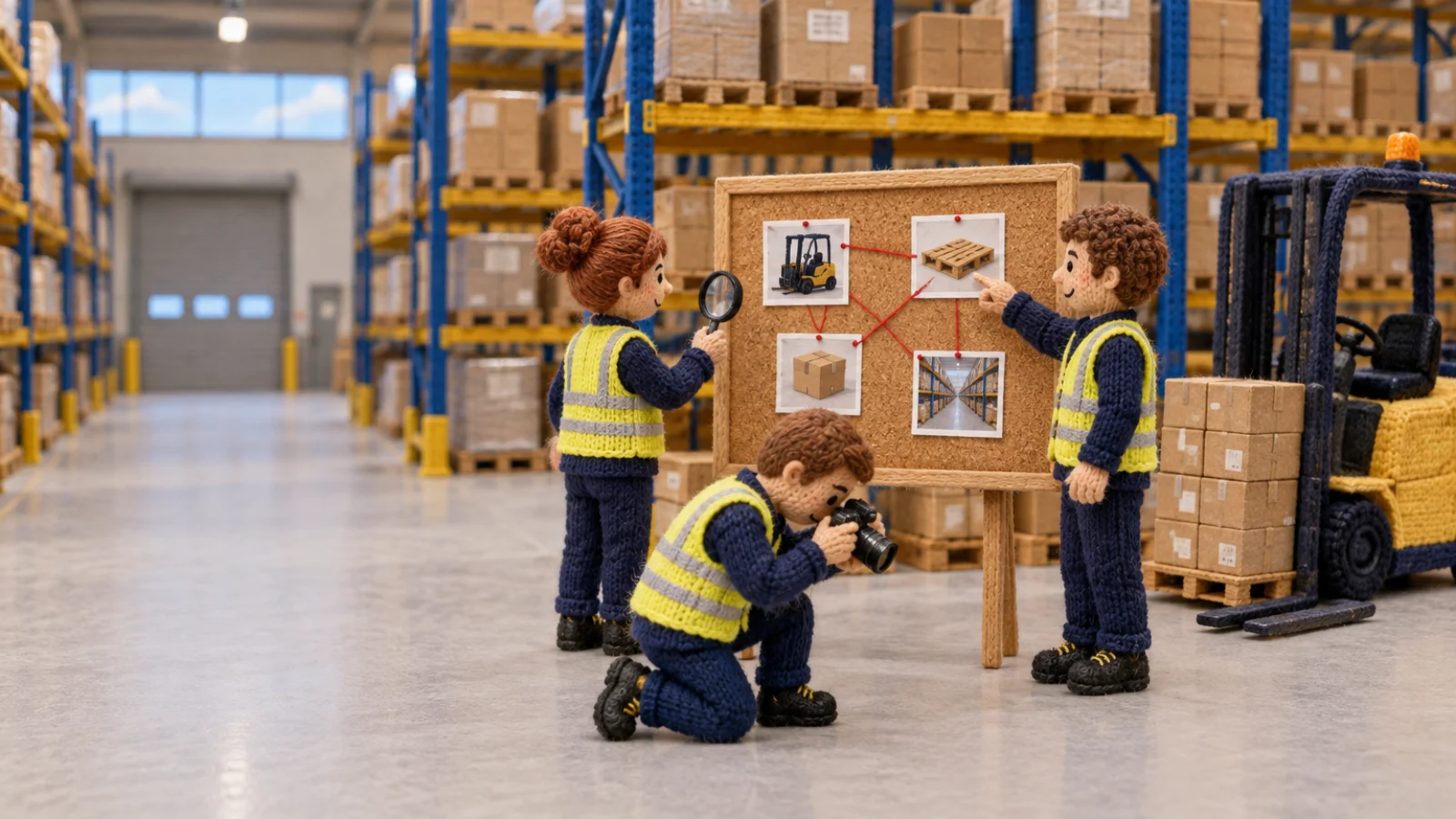
The same knitted-wool warehouse. The boxes are restacked, and three investigators stand by a pinboard of photos joined by red yarn into a cause map. One points at it, one holds a magnifying glass, one photographs the forklift's forks.

Evidence pinned. Causes found. A fair answer.

Bring a recent event from your own operation, and we will walk the investigation through Petowo with you.