
PetowoPetowo
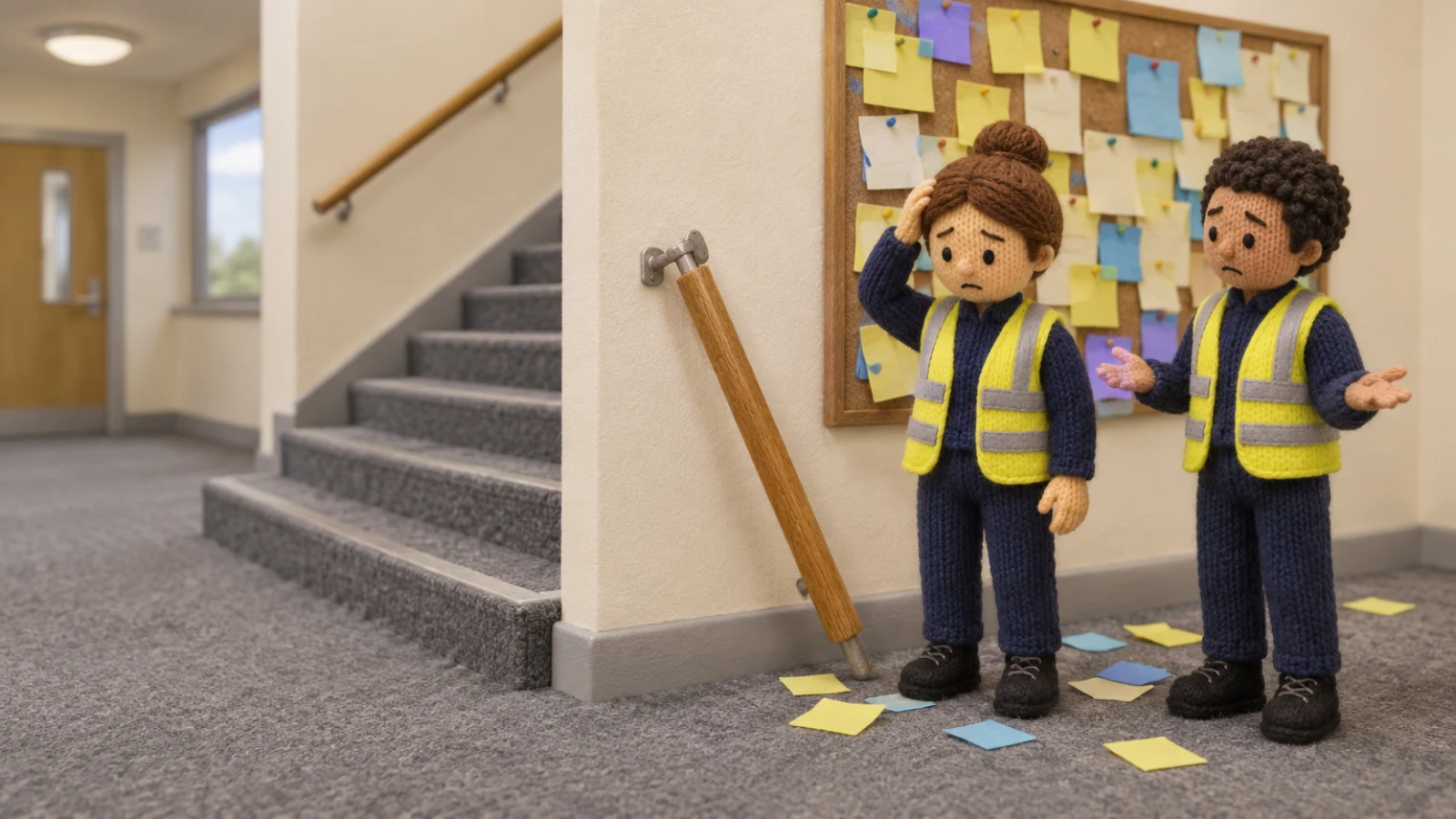
A knitted-wool illustration of a tired supervisor and a colleague in front of a cork board crammed with faded sticky notes, some fallen on the floor, beside a stair handrail hanging loose off its brackets.

Solutions / Actions

Close actions for real, not just on paper.

For whoever owns the fixes. Every action has an owner and a date, and someone else checks the work.

  • Anyone can report from their phone

  • See which controls are really working

  • Fixes are checked before they're closed

  • Your information stays private to you

The problem in your words

Does any of this sound familiar?

  • Closed on paper

    The system says closed. The rail is still loose.

    Someone ticked the box and moved on. Nobody went to look, and the next person found it the hard way.

  • Lost across lists

    Actions live in five different spreadsheets.

    One from the audit, one from the incident, one from a meeting. Nobody can see them all at once, or say who owns what.

  • Dates keep slipping

    The due date moves and nobody says a word.

    It gets pushed back a week at a time, until everyone forgets why it mattered. Then the auditor asks.

Closed means done, and checked.

  • Lost across lists

    One owner, one date, one list

    Every action has one owner and one due date, whether it came from an incident, an inspection, an audit or a morning huddle. Each one shows where it came from, and work someone noticed on a walk can stand on its own.

  • Closed on paper

    Checked by someone else

    When the work is done, someone who neither owns it nor did it checks it before it closes. If it is not done, they send it back to the owner and say what is missing.

    The actions list, then one action that is closed only after an independent verification step done by someone other than its owner.

    Closed means checked, by someone who did not do the work.
  • Dates keep slipping

    More time needs a reason

    The owner asks for a later date and says why. Someone else approves or declines it. The first due date and every extension stay on the record.

  • Closed on paper

    Say how strong the fix is

    Mark where an action sits in the hierarchy of control, from removing the hazard down to PPE. A guard on a machine and a reminder at a briefing no longer read the same.

  • Closed on paper

    Is it still working?

    Plan a day to look again. A colleague who neither owns the action nor did the work records whether it worked, with what its controls have recorded since it closed in front of them.

    At Riverside Cross-dock, Barrier Health flags pedestrian segregation as in place but not holding. Its page shows every check found it in place, it failed in two incidents, and no near miss named it. The site manager raises a fixed barrier at aisle 4, someone independent verifies the work, a new inspection finds it in place, and the verdict turns to Holding.

    Checks said it was in place. Two incidents said it wasn't. Fixed, checked, and holding.
  • Make it yours

    Action types come ready to use. Rename them or add your own, and an update never overwrites what you have changed.

Works with what you do already

Every action knows where it came from.

An action stays joined to the record it was raised from, and anyone who can edit it can connect it to another.

Potentially relevant

  • Where it came from

    The incident, inspection, audit or huddle it was raised from.

  • Any record you connect

    Joined by a person, with one word offered: “Relates to”.

  • The controls it is about

    What those controls have recorded since the action closed.

Petowo shows what these records have in common. Your people decide what it means.

Standards it helps you evidence

Petowo keeps the records. It does not certify you, and your auditor makes the judgement.

ISO 45001, clause 10.2
Helps you evidence that corrective action was taken, and that someone went back to see if it worked.
ISO 45001, clause 8.1.2
Helps you evidence where each fix sits in the hierarchy of control.

What people ask us

We are a small team. Does someone else really have to check?

Yes. One person cannot own an action, do it and check it. The check is what makes “closed” mean something, so it needs a colleague who did not do the work.

What happens when an action is overdue?

It stays with its owner for as long as it is owed, however late it gets. Once it is more than 14 days past its date, the person who raised it and whoever leads that place are told as well, so it does not rest with one person.

Can an action be raised without an incident?

Yes. Someone can raise work they noticed on a walk with no record behind it, and it is treated like any other action. If it later turns out to belong to an incident, it can be connected then.

Can we change or drop an action?

Yes, with a reason. The owner asks for a later date or for the action to be withdrawn, and a colleague who does not own it approves or declines. The request, the reason and the answer all stay on the record.

Can we see every action in one place?

Yes. Every action sits on one list, whatever raised it, and each one says where it came from. Each person also has a list of the work that is theirs, so nobody has to ask what they owe.

Does every action need an effectiveness check?

No. Plan one where it matters. Choose the day someone will look again. It can only be recorded once the work has been checked, and only by someone who neither owns the action nor did it. If the fix did not work, that is recorded too.

A knitted-wool illustration of a worker fixing a yellow stair handrail with a spanner while a supervisor grips it to test it and ticks a clipboard, and a colleague walks down the stairs holding the rail, smiling.

The rail is fixed. The action is closed, and checked.

Bring an action that keeps coming back, and we will walk it through Petowo with you.